

7 Key Differences Between Carvana, CarMax, and Dealer Auctions

Deciding how to sell your car online usually comes down to three paths: the tech giant (Carvana), the retail superstore (CarMax), or the wholesale battlefield (Dealer Auctions). For most sellers, the choice is confusing. Do you want the convenience of an instant offer, or are you leaving thousands of dollars on the table by avoiding the open market? At Bidbus, we believe in the power of the auction. While Carvana and CarMax offer a "take it or leave it" retail approach, auctions are where the pros go to determine the real value of a vehicle. Here is the breakdown of the 7 key differences between these models and why understanding them is the key to maximizing your sale price.
The biggest difference lies in who is actually pricing your car.
Carvana and CarMax use algorithms. You type in your VIN, and a computer estimates what your car is worth based on their current inventory needs. It is a static, one-way offer.
Dealer Auctions are dynamic. They are the engine room of the automotive industry where professional dealers compete.
The Bidbus Difference: We unlock the dealer auction for you. Instead of one computer generating a price, we put your car in front of 1,000+ live dealers who bid against each other.
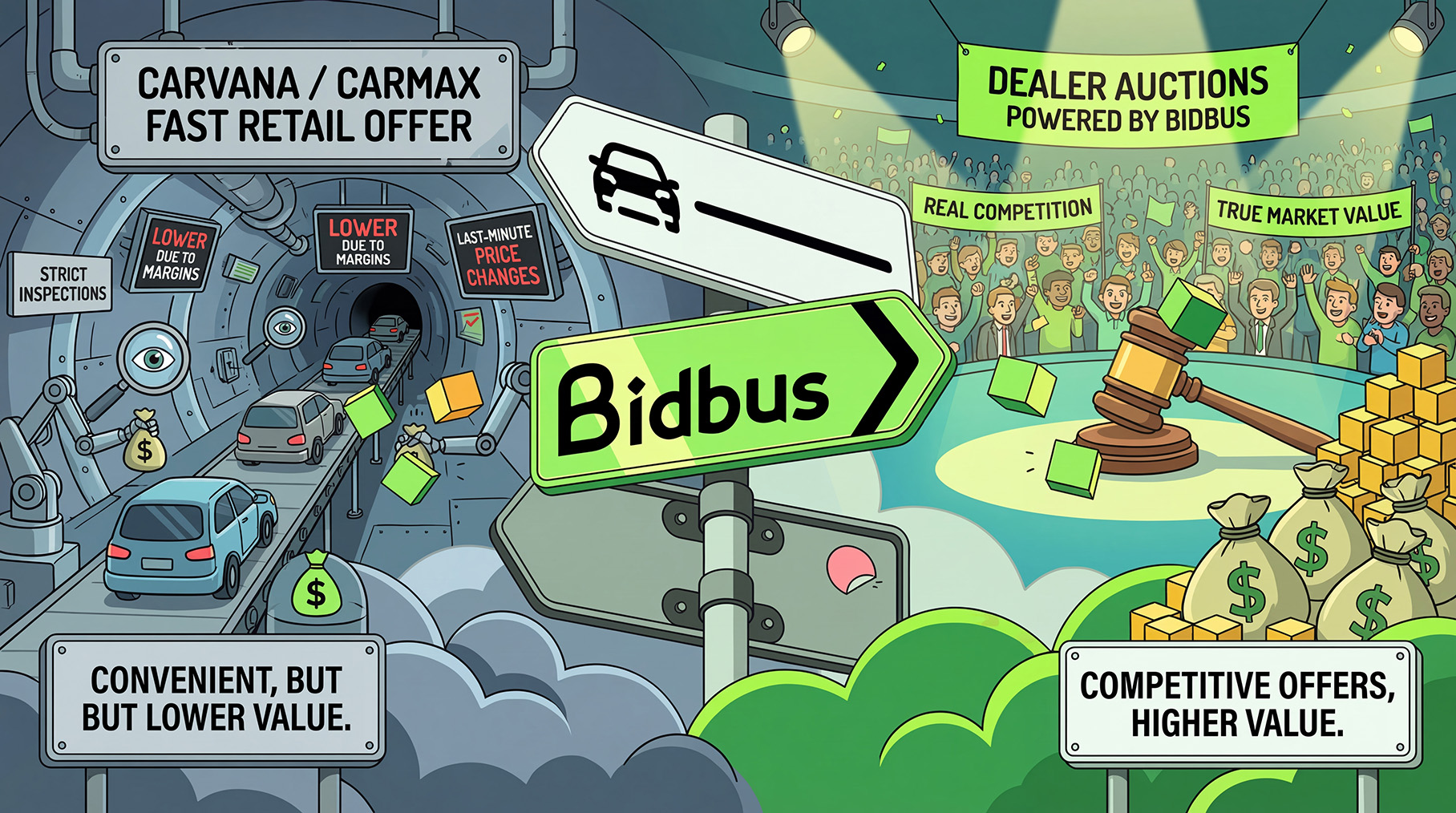
If you are selling, inspection standards dictate how picky the buyer will be about every little scratch.
Carvana and CarMax are retailers. They buy your car to sell it directly to another consumer. Because of this, they are looking for "retail-ready" condition. If your car has dings, dents, or needs tires, they often hit you with a heavy deduction because they have to fix it to meet their "Certified" standards.
Dealer Auctions transact in wholesale condition. Dealers are professionals who have their own body shops and mechanics. They expect a used car to look like a used car.
The Bidbus Difference: Because our buyers are dealers, not picky retail customers, they are often more forgiving of normal wear and tear, meaning less "nit-picking" on your final offer.
This replaces the "Return Policy" concept for sellers. Your main risk isn't returning the car; it's having the offer changed at the last minute.
Carvana and CarMax provide "contingent" offers. You get a price online, but it isn't final until they inspect the car in person. It is not uncommon for a seller to expect $25,000, only to have the rep spot a scratch in the driveway and drop the offer to $24,000 on the spot.
Dealer Auctions rely on binding bids.
The Bidbus Difference: We operate on transparency. As long as you are honest in your initial condition report, the price the dealer bids is the price you get. There are no surprise re-negotiations at the curb.
CarMax buys for CarMax. If they already have 50 Honda Civics on their lots, they don't need yours, and their offer will reflect that low demand.
Carvana buys for Carvana. They are limited by their own inventory levels and stock prices.
Dealer Auctions have unlimited demand.
The Bidbus Difference: We broadcast your car to over 1,000 dealers across the country. If one dealer is overstocked, another is desperate for inventory. You aren't limited to the needs of a single company.
Carvana and CarMax typically give you an offer that is valid for 7 days. This allows you to shop around, but the process of scheduling the pickup or appointment can sometimes drag out.
Dealer Auctions move at the speed of light.
The Bidbus Difference: Our auctions are 2-hour live events. You don't wait days for an offer to come through. You list the car, the auction runs for 120 minutes of high-intensity bidding, and you have a result the same day. It is the fastest way to find true market value.
This is the most important section for your wallet.
Carvana and CarMax are businesses that need to buy low and sell high. Their "Instant Offer" includes a built-in margin for their overhead, advertising, and future profit. You are essentially paying a "convenience fee" in the form of a lower offer.
Dealer Auctions are for "Price Discovery."
The Bidbus Difference: We give private sellers access to price discovery. Instead of one lowball offer from a retailer, you get multiple bids. By bypassing the middleman's retail markup, you keep more of the equity in your pocket.
The automotive market is volatile.
CarMax and Carvana are publicly traded companies subject to stock market pressures. If their stock dips or they face liquidity issues (as seen in recent news cycles), they may tighten their buying criteria overnight, leading to lower offers for everyone.
Dealer Auctions are decentralized.
The Bidbus Difference: We insulate you from the risk of a single company's financial trouble. Because thousands of independent dealers participate in our marketplace, the demand for your car remains stable even if one big retailer stops buying.
Who can access dealer auctions compared to Carvana and CarMax? Traditionally, dealer auctions are limited to licensed dealers with special credentials. Carvana and CarMax are open to the public. Bidbus is the bridge that allows the general public to access the dealer auction network.
Why is an auction often better than an instant offer? Competition. An instant offer is a single opinion of value. An auction forces multiple buyers to fight for your car, which naturally drives the price upward.
Does a 2-hour auction mean I have to sell instantly? You have a 2-hour window where the bids come in, but you aren't forced to sell unless your Reserve Price is met. It gives you the speed of an instant result with the safety of a price floor.
Do I have to fix my car before selling on Bidbus? No. Unlike retailing to a picky consumer, selling to dealers means you can sell the car "as-is." Dealers have the resources to fix issues cheaper than you can, so it's often better to sell it in its current condition.
What happens after the 2-hour auction ends? If your reserve is met, the sale is binding. We connect you immediately with the winning dealer to arrange payment and pickup, often completing the paperwork within 24 to 48 hours.

Sell your car fast,
for more
Get your top dollar offer fast - We let 1,000's dealers compete to buy your car online.