

Avoid Lowball Offers: Secure the Best Cash Quote

An offer that barely covers your loan payoff can feel disappointing. But your loan balance does not determine the car’s market value, and a disappointing offer is not automatically dishonest.
The strongest response is a consistent comparison: give buyers the same vehicle information, get written offers, and calculate what you keep after costs. Competition helps you test an offer. It does not guarantee that every dealer will pay more.
Understand What Lowball Offers Are—and Why They Happen
An offer may be low relative to other buyers’ offers for the same vehicle in the same condition. But retail asking prices are not completed transactions, and a retail listing is not directly comparable to a dealer purchase offer.
Vehicle condition, title history, mileage, local demand and each buyer’s intended use can affect the amount offered. Some offers are negotiable; others are fixed. Treat a low quote as a reason to collect evidence, not proof that you must negotiate or that the next offer will be higher.
Bring a Second Buyer to the Table
Compare the three main routes before committing:
CarMax accepts online offer requests and offers eligible home pickup, subject to location/distance restrictions and a possible fee. Carvana offers direct online purchases, free drop-off and eligible pickup for a location-dependent charge shown at scheduling. Both require accurate vehicle information and verification. Use the actual written quote rather than assuming either buyer’s pickup is universally free.
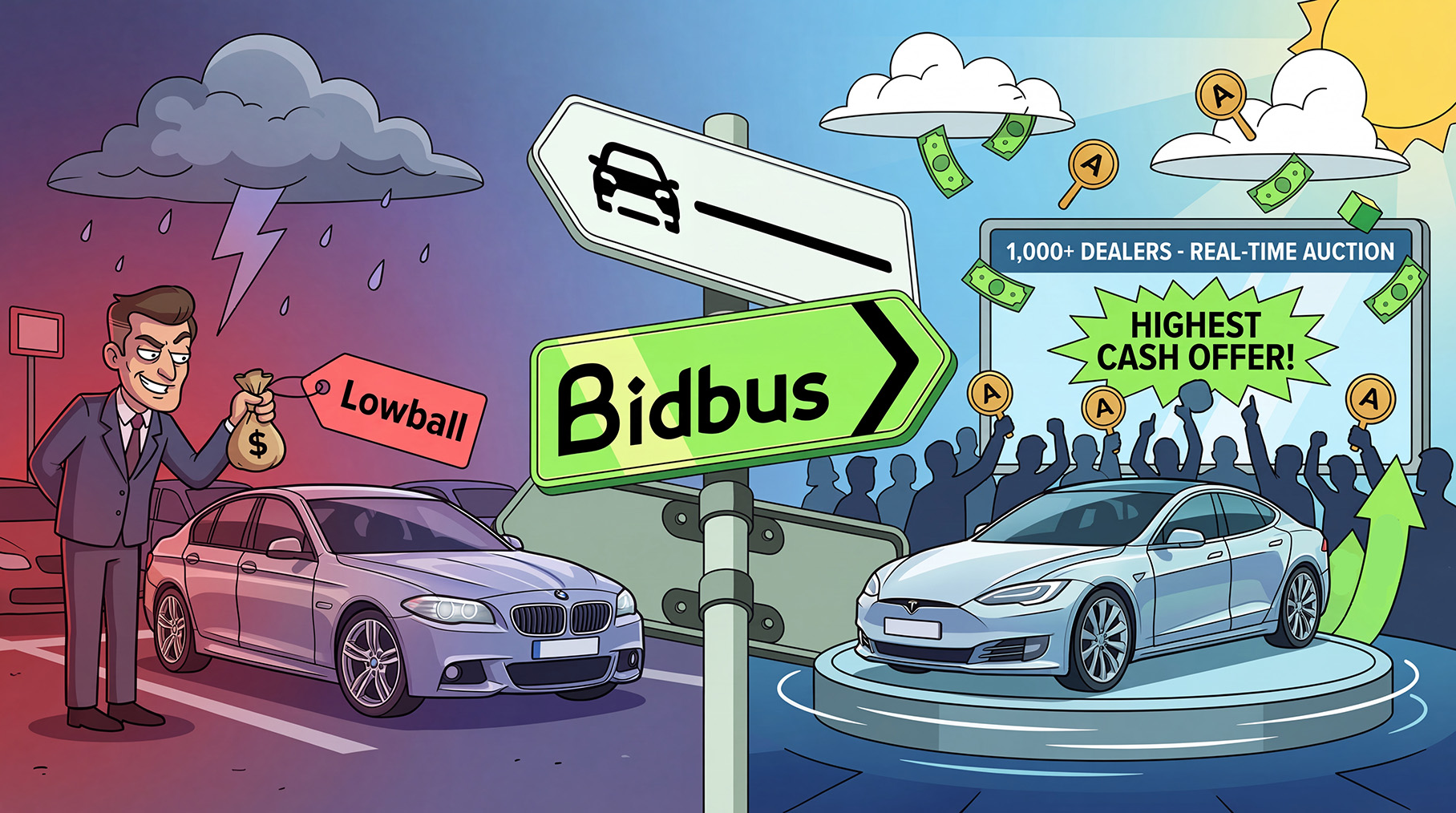
Bidbus describes a network of 1,000+ verified franchise and independent dealers. The network’s size is not a guarantee that every dealer will bid on your vehicle. You can follow the live auction and view dealer bids in one place, making the competing offers visible without guaranteeing that they will beat another buyer’s net offer.
With Bidbus’s dealer auction, dealers can bid for your vehicle during a two-hour window. That can expose the car to different buyers, but dealers still decide what it is worth to them. “Dealers never lowball” is not a reliable rule.
Use a Same-Condition Offer-Comparison Process
- Create one vehicle record. Use the same VIN, trim, current mileage, location, title status, accident history, keys and condition description for every buyer. Photograph damage and record mechanical problems. Bidbus requires written dashboard disclosures; verbal updates alone are insufficient.
- Collect dated written direct offers first. Record their expiry, pickup/drop-off charges, inspection conditions and payment method. Do this before entering an auction that may bind you to sell.
- Separate quotes from completed verification. If an inspection changes an offer, keep the revision and explanation. Compare verified amounts wherever possible. Do not present a preliminary quote as an unconditional sale price.
- Calculate net proceeds. Subtract seller fees, service charges, current lender payoff, outstanding vehicle charges and travel. Keep any replacement-car tax benefit separate so it is not confused with cash paid for the old car.
- Choose a realistic minimum before listing. Your auction floor is a gross sale price. Allow for the platform fee and other costs when deciding the amount you can accept.
A fair payout comparison requires current written offers for the same car using the same disclosures. An unrelated seller’s result or an unsupported average uplift cannot establish which route will pay you more.
Know When an Auction Becomes a Commitment
The Bidbus Seller Terms & Platform Rules provide the fee and commitment details. Meeting the minimum during the live auction makes the vehicle sold. An unmet reserve automatically enters Buy Now for 24 hours after Monday/Wednesday auctions or 48 hours after Friday auctions; a dealer meeting the minimum there also triggers a binding sale. To opt out, text support immediately after the auction ends. Accepting a lower or later offer is binding too.
Exclusivity applies to other auction/private-marketplace listings during active windows. Seller violations can trigger a $300 cancellation fee below $30,000 or 1% at $30,000 or more. A card hold equal to the seller fee is required for scheduling; the fee is charged separately after delivery.
Normally you deliver within three business days, within the standard 100-mile straight-line radius or your pre-auction selected range, and pay for your ride home. The dealership pays you directly. Two hours is not a promise of cleared funds: payment varies by dealer, and positive equity can be held pending clear title. Material undisclosed issues can justify withdrawal or a price-adjustment request under the terms.
Texas Example: Include the Trade-In Tax Effect
A higher standalone offer is not always the best total result when you are also buying a replacement vehicle. Texas permits an eligible trade-in allowance to reduce the replacement vehicle’s taxable selling price. The trade must be part of the same sales transaction and transferred directly to that seller. Proceeds from a private sale or a sale to a different dealer do not qualify for that deduction. See the Texas Comptroller’s trade-in rules.
Hypothetical Texas illustration—not an actual quote or a rule for other states: Assume a $35,000 replacement vehicle, a qualifying $20,000 trade-in to the same seller, and Texas’s 6.25% motor vehicle sales-tax rate. Ignore other charges and assume no loan:
- Eligible trade-in: ($35,000 − $20,000) × 6.25% = $937.50 tax.
- Separate sale, no qualifying trade-in: $35,000 × 6.25% = $2,187.50 tax.
- The eligible trade-in reduces tax by $1,250 in this example.
A hypothetical $21,000 standalone private sale with assumed $0 selling costs pays $1,000 more for the old car, but loses the $1,250 deduction benefit. Holding the replacement price and every other charge equal, it leaves the seller $250 worse off overall. Private-sale costs would widen that difference. A sale through Bidbus to a different dealer also does not create the same-transaction trade-in deduction; include its seller fee as well.
This example is for an owned vehicle in a qualifying Texas transaction—not a lease buyout, a universal tax rule or a promised private-sale premium. If you are not buying another vehicle, there is no replacement-purchase trade-in benefit to add. Compare the complete purchase paperwork when a trade-in is involved.
The Bottom Line: Make Buyers Compete on the Same Facts
Get more than one written offer, disclose the same condition, subtract the real costs and account for any applicable trade-in tax benefit. Choose the strongest verified overall result—not simply the largest bid or the loudest promise.


Sell your car fast,
for more
Get your top dollar offer fast - We let 1,000's dealers compete to buy your car online.