

Selling Your Car Privately vs. Dealer Auction: Is the "Extra Cash" Worth the Risk?

Selling Your Car Privately vs. Dealer Auction: Is the “Extra Cash” Worth the Risk?
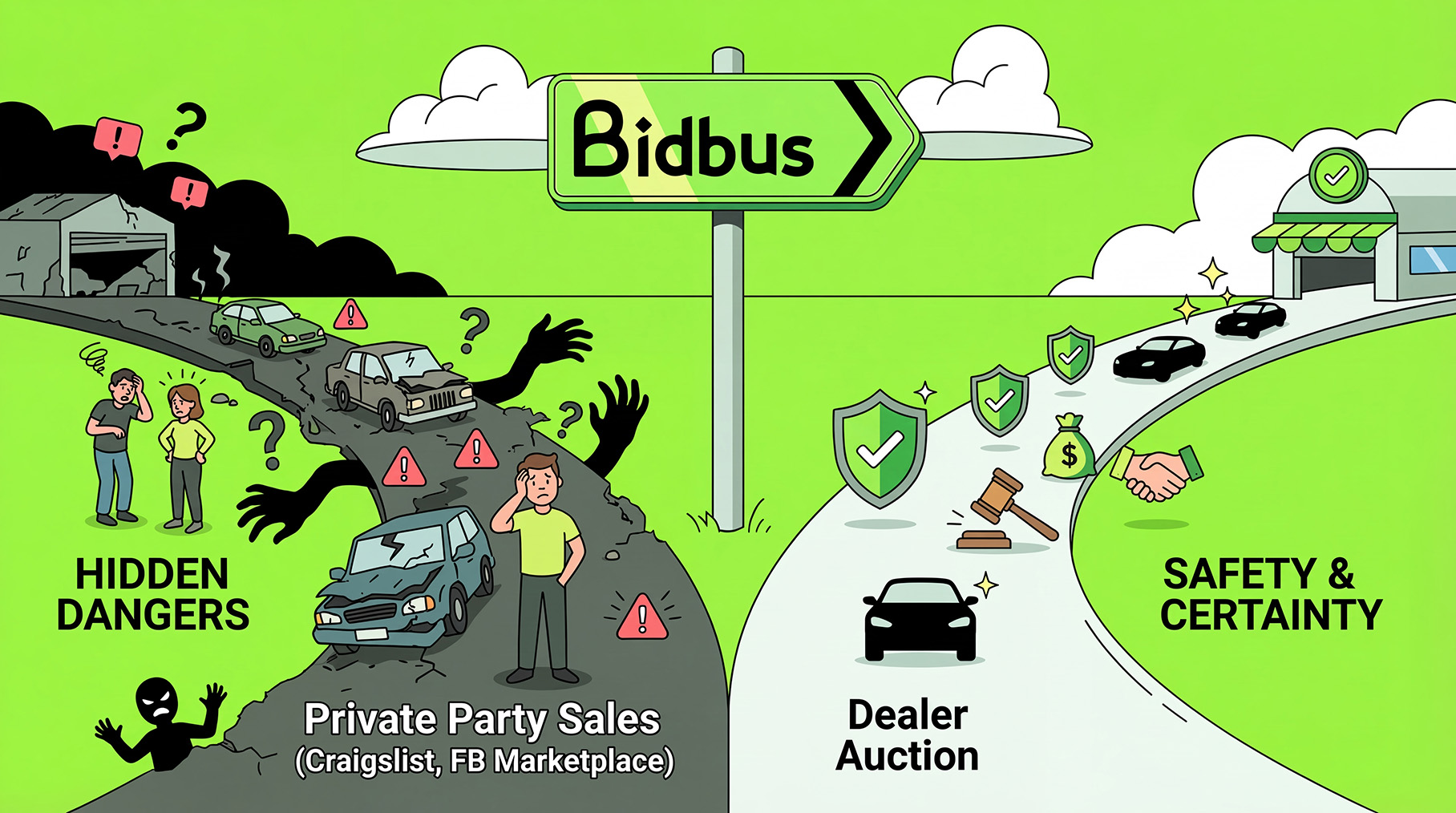
Selling privately can produce a higher price, especially if you find a buyer who wants your exact vehicle. But the asking price is not the amount you keep, and handling a sale takes work.
A dealer auction offers a different trade-off: fewer individual buyer conversations, a dealer purchasing the car, and platform fees and commitments to account for. Neither route is automatically the better financial choice or free of risk.
Compare Net Proceeds and Workload
Use a realistic agreed sale price—not an optimistic listing price. Subtract selling costs and the current loan payoff. Keep the value of your time separate unless you deliberately assign it a dollar amount.
Hypothetical example—not observed results: Suppose a private buyer agrees to $22,000, with assumed listing, preparation and payment costs of $250. That leaves $21,750 before loan payoff. A $21,500 Bidbus sale, less the $300 fee and assumed $50 travel cost, leaves $21,150. The private sale is $600 ahead in this example, before valuing your time. If both routes have the same $8,000 payoff, the remaining equity is $13,750 versus $13,150. Different offers or expenses can reverse the result.
The Bidbus seller terms specify that the fee is charged separately to your card after delivery, following an authorization hold. Include it in net proceeds even if the dealer’s purchase payment does not show that deduction.
The “Stranger Danger” Reality
A private listing does not require inviting buyers to your home. You can arrange a suitable public meeting place, bring someone with you and check identification and insurance before discussing a test drive. Agree on the route and safeguards first.
Bidbus changes who you deal with; it does not mean you never meet the buyer. You normally deliver to the winning licensed dealership within three business days, within the standard 100-mile straight-line radius or your pre-auction selected range. You meet dealer staff, complete inspection and sign documents. Arrange and pay for your own return trip.
Confirm the dealership’s identity and appointment details through independently verified contact information. An online auction reduces the need to manage multiple private viewings, not the need for a real handover.
The Payment Scam: Verification Still Matters
The FTC warns that funds appearing in your account do not prove a check is genuine. Counterfeit checks can look like cashier’s checks or business checks, and fraud can take weeks to discover. Reject overpayments and requests to send money back to a buyer or an unrelated party.
For either route, independently verify the payer and payment instructions. Ask your own bank how to verify the proposed payment and distinguish funds availability from final collection. Do not treat a screenshot, email confirmation or a check bearing a business name as proof of completed payment.
With Bidbus, the dealer—not Bidbus—issues the purchase payment. Same-day payment is not guaranteed. Some dealers issue payment later, and a financed vehicle’s positive equity may be held until clear title arrives; the terms give an estimated two-to-four-week timeframe for that situation. Get the method, timing and any lien/title conditions in writing before handover. A licensed buyer does not make every payment fraud-proof or irreversible.
The “Curbstoning” Liability Trap
Unlicensed dealing and improper title handling are genuine concerns, but a delayed title application is not by itself proof of curbstoning. Nor does a bill of sale instantly remove every possible seller liability.
Bidbus’s terms say the dealer supplies the sale, odometer and release forms and handles dealer DMV filings. Bidbus itself does not process DMV paperwork. You still need to follow the rules that apply to you:
- California: DMV requires notification within five calendar days after the sale/transfer and delivery of possession. Submit complete Notice of Transfer and Release of Liability information and save confirmation. An NRL does not itself transfer ownership or remove your name from the vehicle record; the buyer must complete the transfer. A court determines compliance if a liability dispute arises.
- Texas: TxDMV recommends a Vehicle Transfer Notification, including when selling to a licensed dealer. A dealer need not title the vehicle in its own name before resale. Filing within 30 days protects you from parking-ticket and toll liability incurred by the buyer, as described by TxDMV. Do not confuse that protection with blanket immunity from every claim.
Keep the signed sale documents, buyer’s legal name and address, VIN, odometer reading, sale date, payment records and filing confirmation. Check your state’s instructions rather than assuming the buyer has completed every step.
The Time Sink: Ghosting and Tire Kickers
Private selling involves replying to inquiries, screening buyers, scheduling appointments and handling possible no-shows. Some cars sell quickly; others require patience or a price change. There is no reliable fixed number of messages or hours for every sale.
Bidbus reduces the need for individual viewings, but two hours describes the live auction—not a completed, paid sale. If the minimum is unmet, Buy Now automatically lasts 24 hours after Monday/Wednesday auctions or 48 hours after Friday auctions. Text support immediately after the auction to opt out, as the terms require. A bid meeting your minimum during the live auction or Buy Now window binds the sale; accepting a lower or later offer does too. Exclusivity applies during active windows, so do not run competing private listings then.
Seller violations can incur a cancellation fee of $300 below $30,000 or 1% at $30,000 or more. Read the obligations before listing, not after a dealer wins.
The “Post-Sale” Headache
Document the vehicle’s condition and disclose known issues accurately. Do not assume “as is” removes obligations concerning fraud, title or required disclosures.
Bidbus dealers may withdraw or request an adjustment for material undisclosed problems under the seller terms. Required written disclosures belong in the dashboard; clear photos help, but subtle defects need written notes. Dealer experience does not excuse inaccurate information or guarantee that no dispute can occur.
The Bottom Line: Safety and Time Have Value
A private sale can be worthwhile when its realistic extra net proceeds justify the work and you can manage payment and paperwork carefully. A dealer auction can make sense when you prefer fewer viewings and are comfortable with the fee, binding-sale rules and handover timeline.
Compare actual offers, verify the payment arrangements, and complete your state filings whichever route you choose.


Sell your car fast,
for more
Get your top dollar offer fast - We let 1,000's dealers compete to buy your car online.