

The "Unbundling" Strategy: Why Trading In Your Car is a Financial Mistake

Walk into any dealership in America and tell the salesperson you want to buy a new car and trade in your old one. Watch their eyes light up.
You just handed them the keys to the negotiation.
For decades, dealers have used a tool called the "4-Square" to manipulate buyers. It is a worksheet divided into four boxes:
Vehicle Price
Down Payment
Monthly Payment
Trade-In Value
When you trade in your car, you allow the dealer to play a shell game with these four numbers. If you fight hard for a higher trade-in value, they simply raise the price of the new car or bump the interest rate to make up the difference. They simply move your money from one box to another. You think you won. The math says you lost.
Here is why the smartest buyers use the "Unbundling Strategy" to protect their profit.
Dealers treat a deal as a "package." They don't care if they lose money on your trade-in as long as they make it back on the new car financing.
The Scenario: You have a car worth $25,000. The dealer offers you $22,000. You demand $25,000. The dealer says, "Okay, let me talk to my manager." They come back and agree to give you $25,000 for your trade. You feel great.
The Trap: While you were celebrating your "win" on the trade, they refused to discount the new car by $3,000, or they held back a factory incentive you didn't know about. They gave you your own money back.
The Fix: You must "unbundle" the transaction. Never discuss a trade-in while buying a car. Negotiate the purchase price of the new vehicle in isolation. When you remove the trade-in from the equation, the dealer has nowhere to hide the numbers.
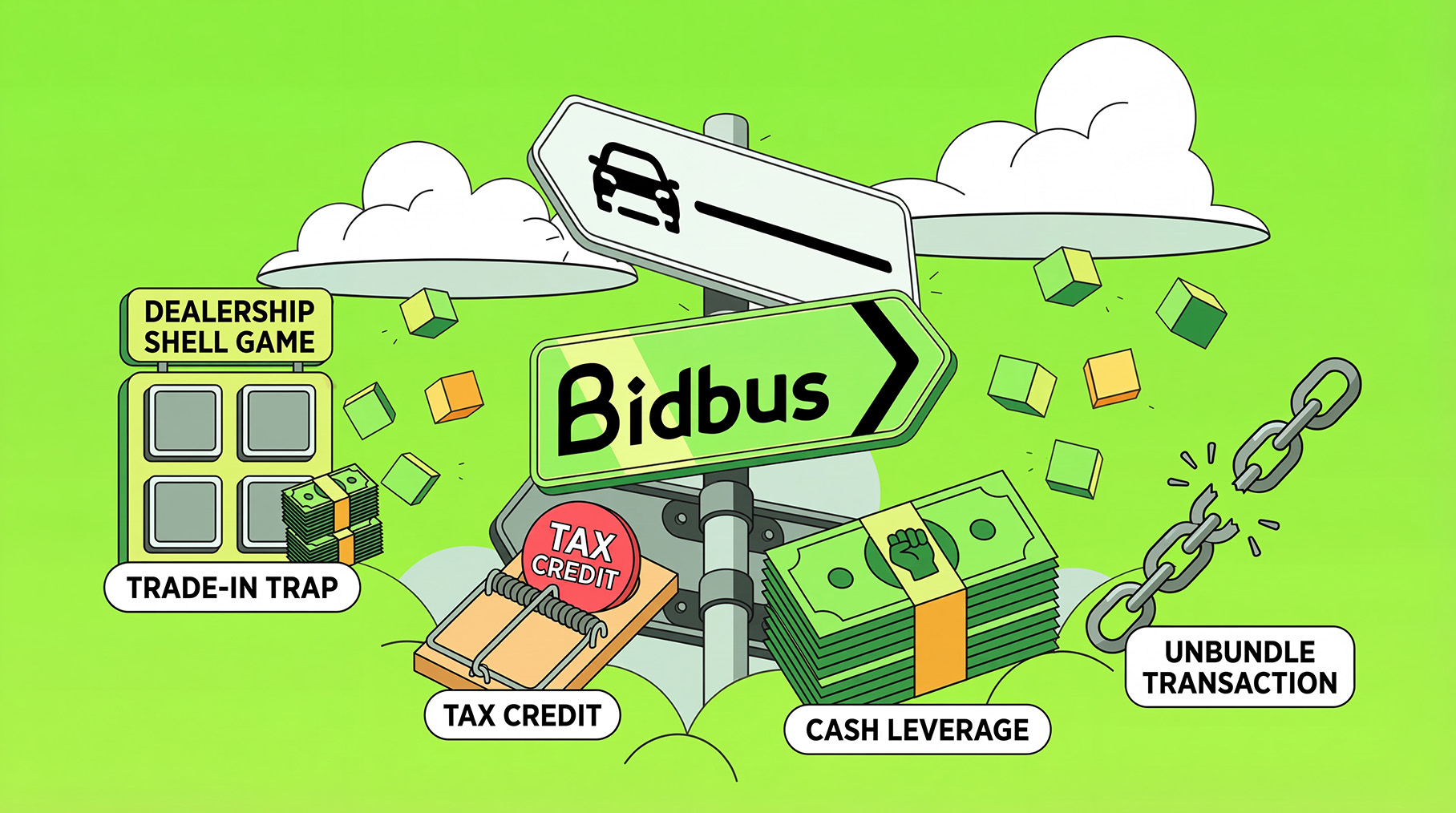
Dealers will try to scare you out of selling separately by screaming about the "Tax Credit."
In many states, you only pay sales tax on the difference between the new car price and your trade-in value.
The Dealer Argument: "If you trade this in for $20,000, you save $1,600 in taxes! If you sell it on your own, you lose that."
The Real Math: The tax savings are real, but they are often smaller than the "Market Loss."
Trade-In Offer: $20,000 + $1,600 Tax Savings = $21,600 Net Value.
Bidbus Auction Result: $23,500 Cash Offer.
In this scenario, even after "losing" the tax credit, you are still $1,900 richer by selling on the open market. Do the math before you believe the myth.
When you sell your car on Bidbus before you step onto the dealership lot, you walk in as a "Cash Buyer."
You have a check in your bank account. You have no trade-in anchor dragging you down. You are simply there to buy a commodity.
Simplicity: The negotiation is shorter.
Clarity: You know exactly what you are paying for the new car.
Leverage: If they don't meet your price, you can walk away to the next dealer immediately because you aren't trying to coordinate a complex vehicle swap.
Complexity favors the dealer. Simplicity favors you.
By selling your car on Bidbus, you convert a complex asset into simple cash. You stop playing the 4-Square game and start playing by your own rules.
Don't let them bundle your losses. Unbundle your deal. Sell your car on Bidbus, then go buy your new one with the power of cash in hand.


Sell your car fast,
for more
Get your top dollar offer fast - We let 1,000's dealers compete to buy your car online.