

Why Kelley Blue Book is Lying to You (And How to Find Your Car's Real Price)

It is the first thing everyone does. You decide to sell your car, so you go to Kelley Blue Book (KBB), type in your mileage, and smile when you see the number: $28,500.
Then you go to a dealer, or get an instant offer online, and the number comes back: $24,000.
You feel insulted. You feel scammed. You think, "They are trying to rip me off. The Book says it's worth $28,500!"
Here is the hard truth that nobody tells you: Kelley Blue Book does not buy cars.
KBB is a guide. It is a fantastic tool for getting a ballpark idea, but it is not a checkbook. If you rely on "The Book" to set your price, you are looking at a map instead of the territory.
Here is why the "Book Value" is often wrong, and why the "Real-Time Market" is the only number that matters.
Book values are based on historical data. They look at what cars sold for in the past (last week, last month, last quarter) to guess what your car is worth today.
But the car market is volatile. It moves fast.
Scenario: Gas prices spike overnight. Suddenly, the value of big V8 SUVs drops by 5% instantly because nobody wants to feed them.
The Glitch: The "Book" hasn't updated yet. It still shows the value from two weeks ago. The dealer, however, lives in the real world. They know they can't sell that SUV today, so their offer drops.
If you hold out for the "Book Value" in a falling market, you are chasing a ghost.
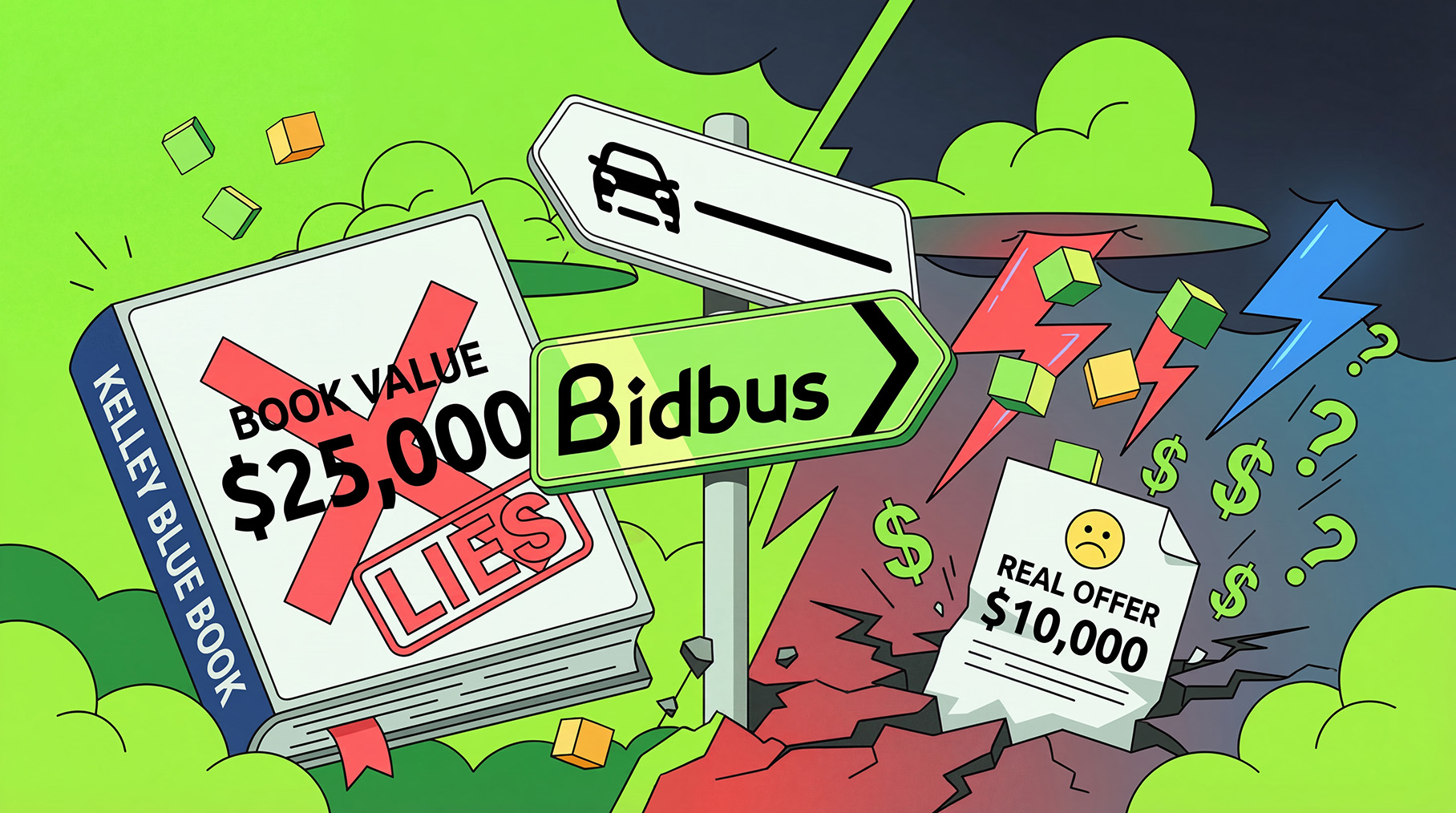
A "Book Value" is a theoretical number. A "Bid" is a commitment of cash.
The Theory: "This car should be worth $28,000."
The Reality: "I will write you a check for $26,500 right now."
The only way to know the true value of your asset is to test the market. If 1,000 dealers compete for your car and the highest bid is $26,500, then your car is worth $26,500. It doesn't matter what the website says. The market is the final judge.
This cuts both ways. Sometimes, KBB undervalues your car.
If you have a rare color combo, a specific package, or a car that has developed a "cult following" (like certain Toyotas or diesel trucks), the algorithm might miss it. It lumps your special car in with the generic ones.
In a live auction like Bidbus, human dealers recognize the rarity.
KBB Value: $15,000 (Generic Average).
Bidbus Dealer: "Whoa, that's the manual transmission model in Speedway Blue. I have a buyer waiting for that." Bids $17,500.
If you had just accepted the "Book Value," you would have lost $2,500.
Be honest. When you select the condition on KBB, do you click "Excellent"? Everyone does.
Fact: Only about 3% of used cars are truly in "Excellent" condition.
Reality: Most daily drivers are "Good" or "Fair."
When you anchor your expectations to the "Excellent" price but have a "Good" car, you set yourself up for disappointment. Dealers bid on the car they see, not the button you clicked.
Stop looking at the Book and start looking at the Check.
The only way to find the true, extractable value of your vehicle is to put it in front of people who actually write checks. Don't argue with a website. List it on Bidbus, let the market speak, and get the real number, not the theoretical one.


Sell your car fast,
for more
Get your top dollar offer fast - We let 1,000's dealers compete to buy your car online.